
Anatomy and Physiology Definition & Scope
Introduction to Human Anatomy and Physiology
Detailed Overview: Anatomy and Physiology for Healthcare Professionals
Human Anatomy and Physiology are the twin pillars of medical science. Without understanding the structure (Anatomy) and the function (Physiology), a medical professional is like a navigator without a map. At BexyHub, we simplify these complex systems into digestible knowledge for nursing officers and students.
The Expanded Scope of Anatomy and Physiology
The scope of this field is vast and covers several specialized branches:
Systemic Anatomy: Study of specific body systems such as the skeletal, muscular, or nervous systems.
Developmental Anatomy (Embryology): Understanding how a single cell transforms into a complex human being from conception to birth.
Clinical Physiology:
This branch is vital for Nursing Officers. It focuses on how physiological processes are altered during disease or injury.
Exercise Physiology: Analyzing how the body responds and adapts to physical stress and exercise—crucial for sports medicine.
Neurophysiology:
A deep dive into the functioning of the brain and nervous system, which is the command center of our existence.
Why Nursing Students Must Master This Subject?
For a Nursing Officer, every action—from giving an injection to monitoring a ventilator—is based on Anatomy and Physiology.
Accurate Assessment:
Understanding normal physiology helps in identifying “Abnormal” clinical signs in patients.
Drug Administration: Knowing the anatomy of veins and muscles is essential for IV and IM injections.
Critical Care: In the ICU, understanding the respiratory and cardiac physiology is the difference between life and death.
The Core Definition:
Beyond the Basics
Human Anatomy: This is not just about naming body parts. It is the scientific study of the body’s structures. Some of these structures are very small and can only be observed and analyzed with the assistance of a microscope (Microscopic Anatomy). Others can readily be seen, manipulated, measured, and weighed (Gross Anatomy).
Human Physiology:
While anatomy is about structure, physiology is about function. It explains the “how” and “why” of the human body. It describes the chemistry and physics behind how the organs work together to support life.
. Definition of Anatomy
Anatomy is the branch of science that deals with the study of the structure of the human body. It describes where different organs are located and how they are connected.
- Simple Meaning: It is the study of “How the body is built.”
2. Definition of Physiology
Physiology is the branch of science that deals with the study of the functions of the human body parts. It explains how different organs and systems work together to keep us alive.
- Simple Meaning: It is the study of “How the body works.”
The Main Difference
- Anatomy: Focuses on the Structure (Example: The heart has four chambers).
- Physiology: Focuses on the Function (Example: How the heart pumps blood to the body).
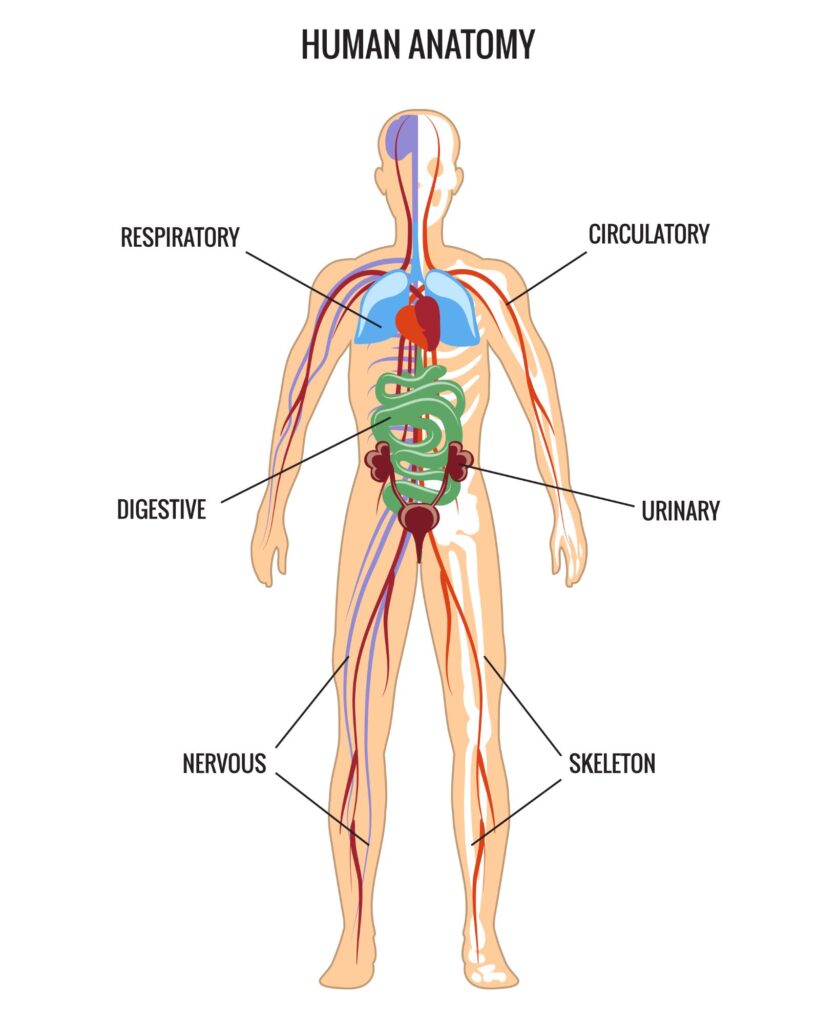
The Vital Importance of Mastering Anatomy and Physiology (Deep Dive)
Understanding the human body is not a one-time task but a continuous journey for healthcare professionals. When we speak about the Scope of Physiology, we are essentially talking about the “Logic of Life.”
Sub-Disciplines within Physiology (The Growing Scope)
To dominate the nursing exams and clinical practice, one must understand that Physiology is divided into several specialized fields:
Cell Physiology:
The study of the functions of cells—the building blocks of life.
Organ Physiology: Focuses on the functioning of specific organs like the heart (Cardiac Physiology) or the lungs (Respiratory Physiology).
Pathophysiology:
This is the most crucial scope for Nursing Officers. It deals with how physiological processes are altered by disease. Without this, one cannot understand conditions like Diabetes, Hypertension, or Cardiac Arrest.
Immunology: The study of how body structures (Anatomy) and functions (Physiology) protect us from foreign pathogens.
Structural Levels of Organization (Anatomical Hierarchy)
Anatomy is best understood when studied through the levels of organization. In our BexyHub modules, we cover:
Chemical Level: Atoms and molecules.
Cellular Level: The basic functional unit.
Tissue Level: Groups of similar cells.
Organ Level: Different tissues working together.
System Level: Related organs (e.g., Digestive System).
Organismal Level: The whole human body.
IV. Why “BexyHub” Approach is Different?
While textbooks provide raw data, BexyHub provides Clinical Correlation.
For 8th to 12th Students: We simplify these definitions into visual maps.
For Nursing Officers: We connect Physiology with ICU Monitoring and Emergency Care.
Knowing that the Left Ventricle is thicker than the Right Ventricle is Anatomy; understanding that it needs more pressure to pump blood to the entire body is Physiology. This “Why” and “How” is what makes you a Dhuraandhar in your field.
V. Frequently Asked Questions (FAQ) – People Also Ask
Q1. What is the simplest definition of Anatomy?
Ans: Anatomy is the study of the structure and relationship between body parts.
Q2. What is the scope of Physiology in Nursing?
Ans: The scope is vast, including understanding vital signs, drug mechanisms, and patient recovery processes. It is essential for clinical decision-making.
Q3. Are Anatomy and Physiology always studied together?
Ans: Yes, because “Structure Determines Function.” You cannot fully understand how an organ works without knowing its build.
Advanced Concepts in Human Physiology:
The Homeostatic Mechanism
To truly understand the Scope of Physiology, one must master the concept of Homeostasis. This is the state of steady internal, physical, and chemical conditions maintained by living systems. This is the condition of optimal functioning for the organism and includes many variables, such as body temperature and fluid balance, being kept within certain pre-set limits.
Negative Feedback Loops:
Most physiological systems in the human body are controlled by negative feedback. For example, the regulation of blood glucose levels or body temperature. When a change is detected, the body works to “negate” or reverse that change.
Positive Feedback Loops:
Though less common, these are vital for specific events like child birth (Oxytocin release) and blood clotting.
Clinical Importance for Nursing Officers:
In an ICU or Emergency setting, a Nursing Officer’s primary job is to maintain the patient’s Homeostasis. Understanding the Physiology of Acid-Base Balance or Electrolyte Regulation is what saves lives during critical shifts.
VII. Future Scope: Anatomy & Physiology in the Age of AI and Digital Health
The study of Anatomy and Physiology is evolving. We are moving from traditional textbooks to:
3D Bio-Printing: Understanding anatomical structures to print artificial organs.
Virtual Reality (VR) in Anatomy: Using VR headsets to explore the human body from the inside, a method we advocate at BexyHub.
Genomics & Personalized Physiology: How a person’s unique genetic makeup influences their physiological responses to treatments
Ward ki Asli “Ground Reality” (Solid Style)
“Dekho bhaiyo, kitabon mein padhna ek alag duniya hai, lekin jab asliyat mein ward mein khade hokar patient ki care karni padti hai, tab samajh aata hai ki asli Nursing kya hoti hai. Maine apni GNM, Post BSc, aur MSc Nursing ki jo padhai kari hai, uska poora nichod aur ICU mein bitaye huye mere hazaron ghanton ka tajurba maine is post mein daal diya hai. Ye koi computer se copy kiya hua maal nahi hai, balki mere apne hathon ki mehnat hai jo maine aapke liye din-raat ek karke likhi hai. Ise dhyan se padhna, kyunki ye aapko ek kabil professional banayega.”
Bexyhub ka “Asli Mission” (Trust Wala Style)
“Maine jab Bexyhub ki neenv rakhi thi, tab mera ek hi lakshya tha: ki hamare nursing students ko wahi saaf aur sacchi jankari mile jo unke career mein kaam aaye. In 125 posts ki har ek line ke piche meri MSc ki research aur mera clinical anubhav chupa hai. Main koi bada machine nahi hoon, main aapka wahi Deepak hoon jo khud in raaston se guzar kar aaj ek Nursing Officer bana hai. Is post mein maine wahi bhasha use kari hai jo hum ward mein ek-dusre ko samjhane ke liye karte hain, taaki aapko rathna na pade.”
Exam nikalne ka “Desi Formula” (Topper Style)
“Doston, NORCET ho ya State PSC, exam nikalne ke liye sirf padhna kaafi nahi hota, balki ye pata hona chahiye ki kya padhna hai. Maine khud ye sab exams diye hain aur aaj ek Nursing Officer ke roop mein kaam kar raha hoon. In notes mein maine un barikiyon ko pakda hai jo aksar exams mein puchi jati hain lekin kitabon mein dhang se nahi milti. Ye content ekdum ‘Human-Made’ hai aur meri imandari ka saboot hai. Ise padho aur khud fark mehsoos karo.”
यह पोस्ट केवल शैक्षिक उद्देश्यों (Educational Purposes) के लिए साझा की गई है। यहाँ दी गई जानकारी मेरे नर्सिंग अनुभव और अध्ययन पर आधारित है। यदि आपको किसी जानकारी पर संदेह है या कोई शिकायत है, तो कृपया कमेंट बॉक्स में बताएं या हमसे संपर्क करें। किसी भी चिकित्सीय निर्णय के लिए पेशेवर डॉक्टर की सलाह अवश्य लें।
Our Specialized Health Education Portal:
Visit Care.Bexyhub.in →