
Vital Signs in Nursing: Normal Ranges and Clinical Importance
What are Vital Signs?
In this article, we will discuss Vital Signs in nursing, their normal ranges, and clinical importance.”
Vital signs are the most basic and essential body measurements used by healthcare professionals to assess a patient’s health status. These signs indicate how well the body’s vital organs are functioning. #vital Signs
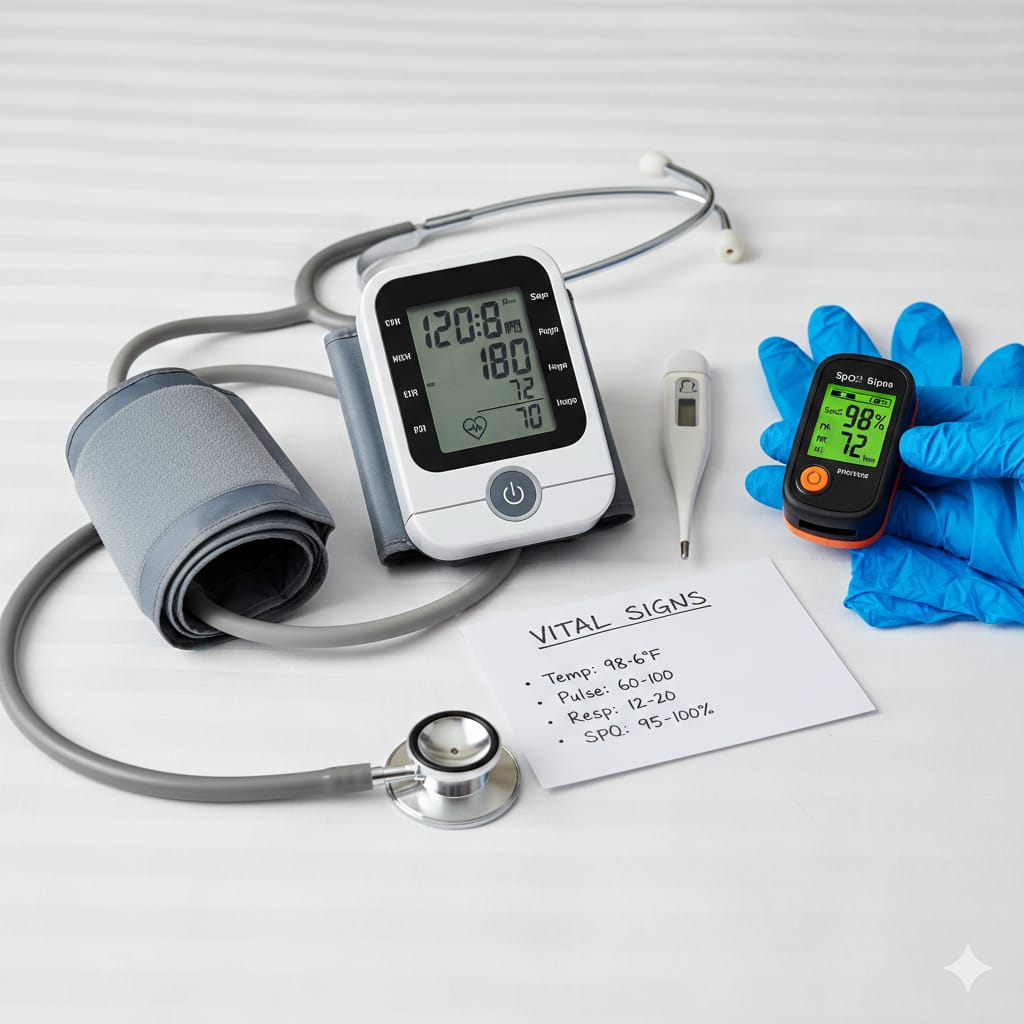
Vital Signs in Nursing
Normal Ranges for Adults:
Body Temperature: 98.6°F (37°C)
Pulse Rate (Heart Rate): 60 to 100 beats per minute (BPM)
Respiration Rate: 12 to 20 breaths per minute
Blood Pressure (BP): 120/80 mmHg
Oxygen Saturation (SpO2): 95% to 100%
Clinical Importance:
Assessment: It helps in the early detection of medical problems.
Monitoring: Vital signs are used to monitor the patient’s response to treatment or medication.
Emergency: Any significant change in vital signs can indicate a life-threatening situation.
Note: These ranges are for healthy adults. For infants, children, and elderly patients, the normal values may vary. #vital Signs
Temperature
“Body temperature measures the balance between heat produced and heat lost by the body. The most common sites to check temperature are Oral, Axillary, and Rectal. For adults, the normal range is 97°F to 99°F.”
Blood Pressure
“Blood pressure is the force of blood against the artery walls. Systolic (top number) represents heart contraction, and Diastolic (bottom number) represents the heart at rest. Hypertension is a major clinical concern in nursing.” #vitalsigns
Pulse Rate
“Pulse rate is the number of times the heart beats per minute. It can be checked at the Radial artery (wrist), Carotid artery (neck), or Apical pulse (heart). Tachycardia is when the pulse is over 100, and Bradycardia is when it is below 60.
Ek FAQ Section jodein (AI Overviews ke liye best):
Q: What is the most accurate site for temperature?
A: Rectal temperature is considered the most accurate for core body temperature.
Q: What is the 5th Vital Sign?
A: Pain is often referred to as the 5th vital sign in nursing assessment.
For more clinical standards, you can refer to the World Health Organization (WHO) guidelines.”
https://www.who.int
Respiration (The 4th Vital Sign) –
“Respiration is the process of breathing, which involves the exchange of oxygen and carbon dioxide. In nursing, we observe the rate, rhythm, and depth of breathing.”
Normal Range: For a healthy adult, the normal respiratory rate is 12 to 20 breaths per minute.
Tachypnea: When the breathing rate is higher than 20 breaths per minute.
Bradypnea: When the breathing rate is lower than 12 breaths per minute.
Pain: The 5th Vital Sign –
“Pain is a subjective experience and is now considered the fifth vital sign in clinical practice. Assessing pain helps nurses provide better patient care and comfort.”
Assessment: Nurses use a pain scale (usually 0 to 10) to measure the intensity of a patient’s pain.
Importance: Monitoring pain is essential because it can affect other vital signs like Heart Rate and Blood Pressure.
Factors Affecting Vital Signs –
“Vital signs are not constant; they can change based on several physiological and environmental factors.”
Age: Infants have higher heart rates and lower blood pressure compared to adults.
Exercise: Physical activity increases the heart rate and respiratory rate to meet the body’s oxygen demand.
Stress and Emotions: Anxiety or fear can trigger the ‘fight or flight’ response, causing a temporary rise in BP and Pulse.
Medications: Certain drugs like beta-blockers or narcotics can significantly lower heart and respiratory rates.
Nursing Responsibilities for Vital Signs –
“As a nursing professional, it is our duty to ensure accurate measurement and documentation of vital signs.”
Accuracy: Always use clean and calibrated equipment (Sphygmomanometer, Thermometer, etc.).
Environment: Ensure the patient is resting for at least 5 minutes before taking Blood Pressure.
Reporting: If you notice any significant deviation from the normal range, report it to the physician immediately
Ward ki Asli “Ground Reality” (Solid Style)
“Dekho bhaiyo, kitabon mein padhna ek alag duniya hai, lekin jab asliyat mein ward mein khade hokar patient ki care karni padti hai, tab samajh aata hai ki asli Nursing kya hoti hai. Maine apni GNM, Post BSc, aur MSc Nursing ki jo padhai kari hai, uska poora nichod aur ICU mein bitaye huye mere hazaron ghanton ka tajurba maine is post mein daal diya hai. Ye koi computer se copy kiya hua maal nahi hai, balki mere apne hathon ki mehnat hai jo maine aapke liye din-raat ek karke likhi hai. Ise dhyan se padhna, kyunki ye aapko ek kabil professional banayega.”
Bexyhub ka “Asli Mission” (Trust Wala Style)
“Maine jab Bexyhub ki neenv rakhi thi, tab mera ek hi lakshya tha: ki hamare nursing students ko wahi saaf aur sacchi jankari mile jo unke career mein kaam aaye. In 125 posts ki har ek line ke piche meri MSc ki research aur mera clinical anubhav chupa hai. Main koi bada machine nahi hoon, main aapka wahi Deepak hoon jo khud in raaston se guzar kar aaj ek Nursing Officer bana hai. Is post mein maine wahi bhasha use kari hai jo hum ward mein ek-dusre ko samjhane ke liye karte hain, taaki aapko rathna na pade.”
Exam nikalne ka “Desi Formula” (Topper Style)
“Doston, NORCET ho ya State PSC, exam nikalne ke liye sirf padhna kaafi nahi hota, balki ye pata hona chahiye ki kya padhna hai. Maine khud ye sab exams diye hain aur aaj ek Nursing Officer ke roop mein kaam kar raha hoon. In notes mein maine un barikiyon ko pakda hai jo aksar exams mein puchi jati hain lekin kitabon mein dhang se nahi milti. Ye content ekdum ‘Human-Made’ hai aur meri imandari ka saboot hai. Ise padho aur khud fark mehsoos karo.”
यह पोस्ट केवल शैक्षिक उद्देश्यों (Educational Purposes) के लिए साझा की गई है। यहाँ दी गई जानकारी मेरे नर्सिंग अनुभव और अध्ययन पर आधारित है। यदि आपको किसी जानकारी पर संदेह है या कोई शिकायत है, तो कृपया कमेंट बॉक्स में बताएं या हमसे संपर्क करें। किसी भी चिकित्सीय निर्णय के लिए पेशेवर डॉक्टर की सलाह अवश्य लें।
Our Specialized Health Education Portal:
Visit Care.Bexyhub.in →